Defense & Intelligence · Moraph software

Foreign Language Translation Workflow for Intel

Route each translation request to a qualified linguist, have a second linguist check it, and track it to delivery

At a glance

For
Linguists and translators who translate, gist and check documents
What it does
Take in requests → Assign the right linguist → Translate, check and certify → Deliver and report
Type and deployment
Moraph software, running in Moraph Apps. Unclassified records only, Connected use only, Moraph cloud, With a managed service.
Availability
Generally available, version 1.4. What this means Release notes
Requirements it supports
Connects to
Request intake systems, Analytic and reporting tools, Personnel data and proficiency testing, Webhooks and 3 more

Book a demonstration See the walkthrough

What it does not do

  • It doesn't translate, transcribe or identify languages. Your linguists translate outside the app; it tracks the request, the people, the checks and the delivery.
  • It doesn't test or certify proficiency. Levels are as recorded from your language program, and retest reminders depend on the test dates entered.
  • It doesn't check translation quality itself. QA results and finding counts are what your reviewer records; the app enforces who may record them.

All 8 limitations

Overview

What you are buying

Run your translation office's workflow for unclassified administrative records in one place. Requests come in from staff or through the Work API, go to linguists by language, proficiency level and workload, are checked by a second linguist in QA review, are certified by a certifying linguist other than the translator where the request needs it, and are delivered with a printable cover sheet. Your linguists do the translating, not the app. Every assignment, QA result, certification and due-date change is kept with who made it, and turnaround, backlog, throughput and quality are reported from your own records.

The problem it solves

Translation requests reach the office from many directions and are tracked in inboxes and spreadsheets. Work goes to whoever is free rather than the linguist qualified in the language and dialect, second-linguist checks are skipped when a deadline presses, and the same terms are translated differently from one linguist to the next. Afterwards nobody can say how long requests took, which languages are falling behind or which translations were checked before they went out.

  • Requests wait while coordinators work out who is free and qualified
  • Urgent requests sit in the same pile as routine ones
  • Recurring terms are translated differently by each linguist
  • Nobody can show which translations a second linguist checked
Who uses it and the requirements it supports

Who uses it

  • Linguists and translators who translate, gist and check documents
  • Requesting offices that follow their requests and receive the translations
  • Mission managers who set request priorities and due dates
  • Intelligence oversight officers responsible for handling rules
  • Translation office managers who set targets, levels and capacity

Requirements it supports

Executive Order 12333, United States Intelligence ActivitiesDoD Manual 5240.01, Procedures Governing the Conduct of DoD Intelligence ActivitiesIntelligence Community Directive 203, Analytic StandardsIntelligence Community Directive 503, IC Information Technology Systems Security Risk ManagementPrinciples of Artificial Intelligence Ethics for the Intelligence CommunityNIST AI Risk Management Framework (AI RMF 1.0)

The product supports these requirements; meeting them remains your organization’s responsibility.

See how it works

A short walkthrough

Illustrative screens with fictional sample data. They show the workflow, not any client’s data or configuration, and the layout of the product itself differs. A live demonstration uses the product with sample data.

  1. Step 1

    The translation queue

    Coordinators start from a queue ordered by priority and due date, with the language, service and review status of each request.

    RequestLanguageRequesting office (fictional)DueServiceStatus
    TRQ-4HN8RWLanguage ASample Office 12Past dueFull translationWaiting for a linguist
    TRQ-9MD3KTLanguage BSample Office 4TodaySummary translation (gist)In QA review
    TRQ-6PX2JCLanguage A, regional dialectSample Office 12In 3 days, at riskFull translationWaiting for a linguist
    TRQ-3RV7WELanguage CSample Office 7In 6 daysFull translationIn translation
    TRQ-8TB5NALanguage BSample Office 4In 12 daysSummary translation (gist)Waiting for a linguist
    Coordinators start from a queue ordered by priority and due date, with the language, service and review status of each request.
  2. Step 2

    Who should take a request

    Each request lists the eligible linguists with why each is suggested and their open workload.

    Request TRQ-4HN8RW · Language A → English (fictional sample)

    Target language
    English
    Words
    4,800 · about 3 working days at the daily rate
    Days waiting
    2
    Service
    Full translation
    Review status
    Waiting for a linguist

    Suggested by workload

    • LNG-5WZ3HD (fictional) · specialty legal · 1 open, 900 words
    • LNG-7KQ2PX (fictional) · 2 open, 3,100 words
    • LNG-2CK6RF (fictional) · 3 open, 5,200 words
    Each request lists the eligible linguists with why each is suggested and their open workload.
  3. Step 3

    Second-linguist QA review

    The QA reviewer, never the translator, records the result and findings by category, and a certifying linguist then certifies where the request needs it.

    Request TRQ-4HN8RW · QA review and certification

    Translated by
    LNG-5WZ3HD (fictional), outside the app
    QA reviewer
    LNG-3JS8VN (fictional)
    QA result
    Passed with corrections
    Findings
    Terminology 2, Grammar and style 1
    Status
    QA reviewed

    Glossary terms for this language pair

    • Example term A (fictional) → approved translation
    • Example place name (fictional) → approved spelling
    The QA reviewer, never the translator, records the result and findings by category, and a certifying linguist then certifies where the request needs it.
  4. Step 4

    The request history

    Every step from receipt to delivery is recorded, so the office can show who translated, who checked and who certified.

    Request TRQ-4HN8RW · History

    1. Received from Sample Office 12 through the Work API, confirmed unclassifiedWork API
    2. Due date set from the target for its prioritySystem
    3. Reminder raised: no linguist after 2 daysSystem
    4. Assigned to LNG-5WZ3HD; translation finished and sent to QA review with LNG-3JS8VNLinguist
    5. QA passed with corrections; translation certified and deliveredSenior linguist
    6. Feedback recorded on delivery: satisfiedRequester
    Every step from receipt to delivery is recorded, so the office can show who translated, who checked and who certified.
  5. Step 5

    Search requests

    Anyone with access searches requests by reference, office reference, language or linguist and sees each request's review status.

    RequestOffice referenceLanguageLinguistReview status
    TRQ-4HN8RWHR-2291Language ALNG-5WZ3HDCertified
    TRQ-5CN2WMHR-2274Language ALNG-5WZ3HDQA reviewed
    TRQ-2FV9KAFIN-0417Language BLNG-4MP9TXDelivered without QA
    TRQ-7GW3LBFIN-0409Language CLNG-2CK6RFIn translation
    Anyone with access searches requests by reference, office reference, language or linguist and sees each request's review status.
  6. Step 6

    Quality

    QA rounds, rework and findings by category show senior linguists where to train and which terms to add to the glossary.

    LanguageQA roundsReturned for reworkMost findingsNext step
    Language A4110%TerminologyExpand glossary
    Language A, regional dialect1233%Accuracy or meaningRecruit or train a linguist in the dialect
    Language B3013%Omission or additionTargeted training
    Language C157%Grammar and styleNo change
    QA rounds, rework and findings by category show senior linguists where to train and which terms to add to the glossary.

In the product

Annotated screens

The current build, with sample data. Select a numbered marker to read what it shows; the same notes are listed under the screen.

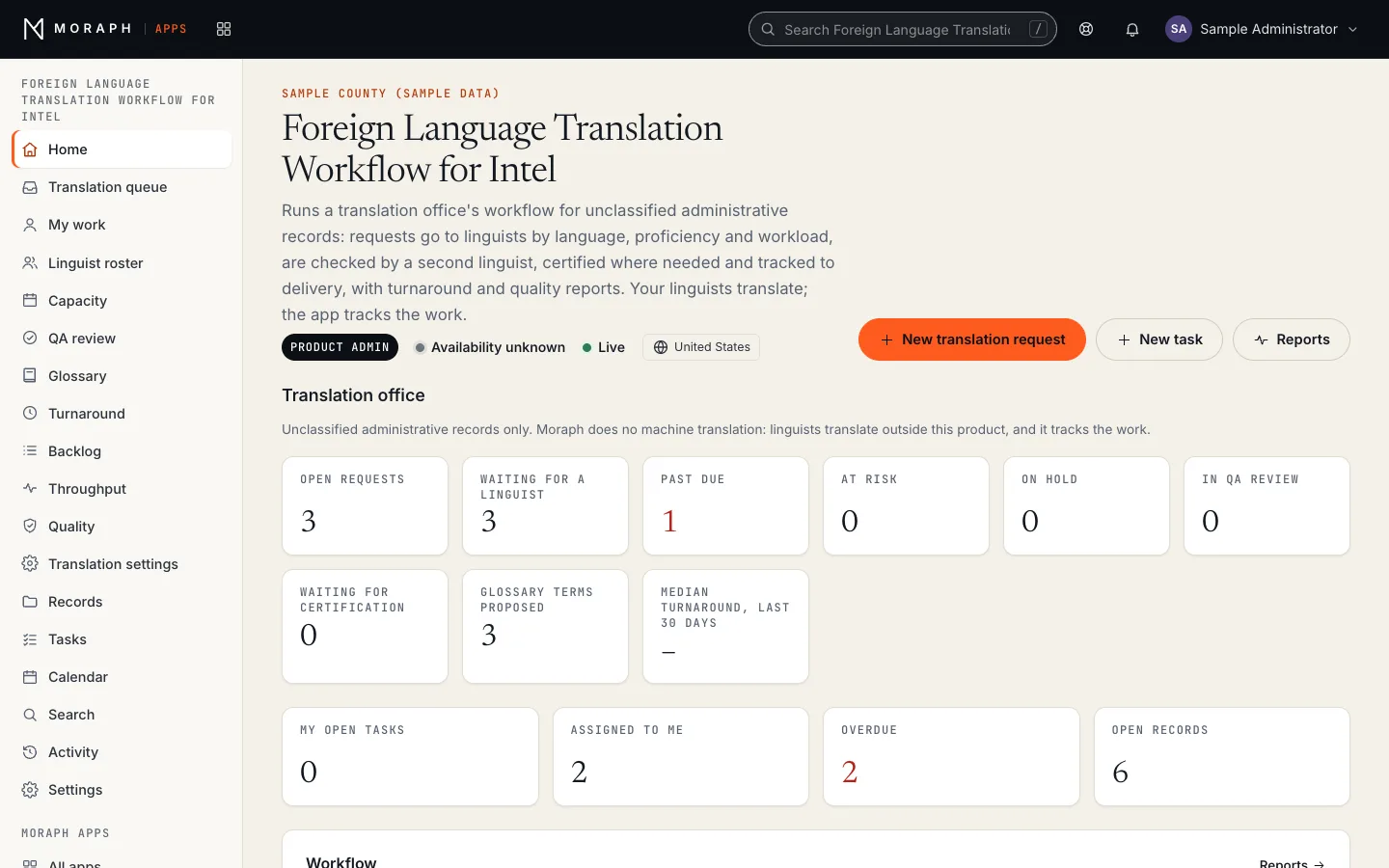
Foreign Language Translation Workflow for Intel in Moraph Apps: the product home for a sample organization, with the Translation office panel; counts for open requests, waiting for a linguist, past due, at risk; workflow stages (Translation requests: Received, Assigned, In translation, QA review, Delivered, Declined, Cancelled). All names and values are sample data.
Foreign Language Translation Workflow for Intel as it runs in the current build of Moraph Apps, with sample data (build dc8154a458, 2026-11-14). Records, names and figures are placeholders, not client data.
Notes on this screen (4)
  1. Product navigation This product’s own pages, then the records, tasks, calendar, search and activity every Moraph product shares.
  2. Translation office Unclassified administrative records only. Moraph does no machine translation: linguists translate outside this product, and it tracks the work.
  3. New translation request Creates a record in this product. A person fills it in; the product checks it against its rules before saving.
  4. Your work Open tasks, records assigned to you, overdue records and open records in this product, counted from its records.

Workflows

The principal workflows

  1. Take in requests

    Requests are entered by staff or sent by your intake system through the Work API, and each must be confirmed unclassified. The due date is set from the priority's target, and the original due date is kept whenever it changes.

    5 steps
    • Request entered by staff or sent through the Work API by your intake system
    • Languages, dialect, subject area and word count recorded with the request
    • Request confirmed unclassified before it can be saved
    • Due date set from the received date and the target for its priority
    • One open request per office reference, so a retried intake doesn't make a duplicate
  2. Assign the right linguist

    The queue lists open requests by priority and due date and suggests a linguist for each: Active, available, at the minimum proficiency level in the language and under capacity, with dialect and subject matches first and then the lightest workload. Coordinators assign one request at a time or all of them by workload.

    5 steps
    • Eligible linguists found by recorded language level, availability and capacity
    • Linguists who work in the dialect or subject area suggested first
    • Lightest open workload, in words and then requests, breaks the tie
    • Requests at risk of missing their due date flagged from the word count and your daily rate
    • Reassignments and due-date changes recorded with a reason
  3. Translate, check and certify

    Your linguists translate outside the app and track their work in My work, where the approved glossary terms for each language pair are listed. When a translation is ready, a second linguist reviews it and records the QA result and findings by category, and a certifying linguist other than the translator certifies it where the request needs it.

    5 steps
    • Linguist opens My work and moves the request to In translation
    • Approved glossary terms for the language pair listed on the request
    • QA reviewer, never the translator, records the result, findings and notes
    • Translations returned for rework go back to the linguist, and each round is counted
    • Certified by a certifying linguist other than the translator where required
  4. Deliver and report

    A request can be delivered only with a passing QA result and any required certification. Once delivered it is locked, a printable cover sheet records who translated, checked and certified it, and turnaround, backlog, throughput and quality reports show how the office is doing.

    5 steps
    • Delivery refused until QA has passed and any required certification is recorded
    • Review status shown on every request: QA reviewed, certified, gist delivered or delivered without QA
    • Printable cover sheet sent with the translation, holding no source text
    • Requester feedback recorded on the delivered request
    • Turnaround measured against the agreed and the original due date, less days on hold

Roles and permissions

Who does what in the product

Your organization's administrators and technical leads give each person one of the roles below in the Moraph Portal under People and access. Each time someone's product access is given, changed or removed, it is recorded in the product's Activity.

Show each role and the permissions matrix

Viewer

Requesting offices, oversight officers and auditors who follow the work without changing it

Follows requests and the office's figures without changing them.

Sees

  • Every request, linguist and glossary term in the workspace
  • The queue, roster, glossary, turnaround, backlog and throughput pages, and Activity

Does

  • Prints a request's cover sheet

Cannot

  • Add, change or move requests, linguists or glossary terms
  • See the Quality report or export the reports as CSV files
  • Change the translation settings or the workspace settings
Approvals
None.
Notified about
Nothing by email.

User

Linguists, senior linguists and translation coordinators

Does the day-to-day work of the office: taking in requests, assigning, translating, QA review, certification and delivery.

Sees

  • Every request, linguist and glossary term in the workspace
  • The Quality report and their own work in My work
  • Their own tasks and the rest of the team's

Does

  • Takes in requests, assigns linguists and QA reviewers, and manages holds, due-date changes with a reason, reassignment and delivery
  • Accepts or declines a request assigned to their own Linguist record
  • Records the QA result when their own Linguist record is the request's QA reviewer, and certifies when their Linguist record certifies translations
  • Proposes glossary terms, and approves terms someone else proposed when their Linguist record certifies translations
  • Records requester feedback

Cannot

  • Record the QA result of their own translation, or a QA result or certification for another linguist's account
  • Certify their own translation
  • Approve a glossary term they proposed, or any term when their Linguist record doesn't certify translations
  • Change their own levels, QA or certification flags, capacity or test date
  • Change a delivered request's details, export the reports as CSV files, or change the translation settings or the workspace settings
Approvals
Records QA results as the request's QA reviewer and certifies as a certifying linguist other than the translator, from their own account. Approves glossary terms someone else proposed when their Linguist record certifies translations.
Notified about
When a record or task is assigned to them, and when work assigned to them is due soon or overdue. The daily reminders (requests past due, at risk or unassigned too long, waiting in QA review or for certification, linguists away with open work, proficiency retests due) arrive as tasks.

Product administrator

The translation office manager

Everything a User can do, plus the translation settings, the CSV exports and corrections to delivered requests.

Sees

  • Every request, linguist and glossary term in the workspace
  • The translation settings and the workspace settings
  • Recently deleted records

Does

  • Sets targets, minimum levels, capacity, the QA and certification rules, reminders and QA scoring
  • Records a QA result or a certification on behalf of the named reviewer or certifying linguist
  • Approves glossary terms someone else proposed
  • Corrects delivered requests and changes linguists' levels and flags
  • Exports turnaround, backlog, throughput and quality as CSV files
  • Changes the workspace's record types, fields and workflow stages, manages Work API keys and restores deleted records

Cannot

  • Give people access to the product or change their roles: your organization's administrators and technical leads do that in the Moraph Portal under People and access
  • Record the QA result of a translation they translated, or certify their own translation
  • Approve a glossary term they proposed
Approvals
Records QA results and certifications on behalf of the named linguists, never on their own translation. Approves glossary terms someone else proposed.
Notified about
When a record or task is assigned to them, and when work assigned to them is due soon or overdue. The daily reminders (requests past due, at risk or unassigned too long, waiting in QA review or for certification, linguists away with open work, proficiency retests due) arrive as tasks.

Permissions at a glance

ActionViewerUserProduct administrator
See requests, linguists, glossary terms and the turnaround, backlog and throughput pagesFullFullFull
Take in, assign and work requests, and deliver themNo accessFullFull
Record a QA result (the QA reviewer's own account or a product administrator; never the translator)No accessApprovesApproves
Certify a translation (the certifying linguist's own account or a product administrator; never the translator)No accessApprovesApproves
Approve a glossary term (a certifying linguist or a product administrator; not the proposer)No accessApprovesApproves
Change a delivered request's detailsNo accessNo accessFull
Export turnaround, backlog, throughput and quality as CSV filesNo accessNo accessFull
Change translation settings and the workspace settingsNo accessNo accessFull
Restore deleted recordsNo accessNo accessFull
Give people access and roles (in the Moraph Portal, by your organization's administrators and technical leads)No accessNo accessNo access
  • Full
  • Approves
  • No access

How access is controlled

  • Only the QA reviewer's own account or a product administrator can record a QA result, never the translating linguist, and only a certifying linguist other than the translator can certify a translation.
  • A request is delivered only with a passing QA result, unless a product administrator turns that rule off, and with its certification where it needs one; delivered requests are locked except for product administrators.
  • A linguist can't change their own levels, QA or certification flags, and glossary terms are approved by someone other than the person who proposed them.
  • Roles are given to each person by your organization's administrators and technical leads in the Moraph Portal under People and access.
  • Each time someone's product access is given, changed or removed, it is recorded in the product's Activity.

Features

What it does

Translation queue

Open requests by priority and due date, with filters for past due, at risk and on hold, each request's age and review status, and the suggested linguist.

Linguist suggestions

Eligible linguists listed for each request, dialect and subject matches first and then the lightest workload, with Assign or Assign all by workload.

Proficiency checks

With the check on, only Active, available linguists at your minimum level in the language can be given a request, and only qualified second linguists can review it.

Linguist roster

Linguists by language and proficiency level, coverage per language against open requests, open workload and proficiency retests coming due.

My work

Each linguist's own list of requests to translate, to review in QA and to certify, and glossary terms waiting for their approval.

Certification

Where a request needs it, a certifying linguist other than the translator certifies it after a passing QA result and before delivery.

Due dates and holds

Due dates set from your priority targets, holds while the requester answers a question, and every due-date change kept with its reason and the original date.

Second-linguist QA review

A QA reviewer other than the translator records the result, finding counts by category and notes, and every rework round is counted.

Review status on every request

Each request shows where it stands, from waiting for a linguist to QA reviewed, certified or gist delivered, on its page, in the queue, on the cover sheet and in the turnaround export.

Glossaries and terminology

Approved translations of recurring terms for each language pair, listed on every matching request, proposed by linguists and approved by a certifying linguist or a product administrator other than the person who proposed them.

Quality

QA findings by category, linguist and language and requester feedback, next to turnaround, on-time delivery, backlog by age and throughput by linguist, with CSV exports.

Handling rules and audit trail

Every request must be confirmed unclassified, delivered requests are locked, and every change, assignment and export is recorded with the person and time.

Reporting

What you can report on

10 standard reports, grouped by who uses them. Each shows who it is for, how it can be broken down, how it is delivered and what it is used for. The data behind them is also available to your own reporting tools.

Show all 10 reports

Operations

Backlog

For translation coordinators and senior linguists

Open requests by language, priority and age band.

Break down by
Language, Target language, Priority, Age band
Delivered as
Live page; CSV export
Used for
Moving linguists to the languages where requests wait longest.

Throughput

For senior linguists and translation office managers

Requests delivered, words, gists and certifications in a period, by linguist and by language pair.

Break down by
Linguist, Language, Status, Period
Delivered as
Live page; CSV export
Used for
Balancing workload and making the case for language staffing.

Turnaround

For translation office managers and requesting offices

Delivered requests in a period, with median and net turnaround and on-time delivery against the agreed and the original due date.

Break down by
Priority, Requesting office, Language, Period
Delivered as
Live page; CSV export
Used for
Showing requesting offices how long translations take and where targets are missed.

Quality

Quality

For senior linguists and translation office managers

QA rounds and results, with findings by category, by translating linguist and by language, and requester feedback by office.

Break down by
Language, QA reviewer, Target language, Finding category, Linguist
Delivered as
Live page for users; CSV export
Used for
Targeting training and glossary work where QA keeps finding the same problems.

Passed QA first time

For senior linguists

From the Throughput report: the share of each linguist's delivered requests that passed QA without rework, with certifications, by linguist and language pair.

Break down by
Linguist, Language, QA result, Period
Delivered as
Live page; CSV export
Used for
Targeting training and showing that translations are checked.

Requester feedback by office

For translation coordinators and senior linguists

Feedback recorded on delivered requests, satisfied or issue raised, by requesting office, with the requests that raised an issue.

Break down by
Feedback, Requester, Review status, Language
Delivered as
Live view; CSV export
Used for
Following up the issues requesting offices raise.

Oversight and audit

Activity: settings changes

For oversight officers

Every change to Translation settings, with who made it and when.

Break down by
Setting, Change date, Changed by
Delivered as
Activity page; CSV export for product administrators
Used for
Showing when targets, levels and checks changed and who changed them.

Activity: exports

For oversight officers

Every report, record and activity export, with who made it and when; report files hold structured fields only.

Break down by
User, Requesting office, Export type, Period
Delivered as
Live view; CSV export
Used for
Checking that exports stay within your office's rules.

Linguist levels and retests

For oversight officers and translation office managers

Each linguist's recorded levels, test date and retest due, with the history of changes to their levels.

Break down by
Language, Linguist, Test date, Changed by
Delivered as
Roster page and Linguist records
Used for
Showing that linguists' recorded levels are current and who changed them.

Activity extract

For oversight officers and auditors

Who changed what and when, for a chosen person, record type or period.

Break down by
Record, User, Action, Date range
Delivered as
Activity page; CSV export for product administrators
Used for
Answering oversight and inspector requests for evidence.
Exports, access and evidence
  • Turnaround, backlog, throughput and quality export to CSV for product administrators and the glossary for users, with structured fields only, and the cover sheet prints or saves as PDF.
  • Reports run for a period you choose, and the records list keeps saved views, so a coordinator or senior linguist can keep their own lists.
  • Requests, linguists and glossary terms are available through the Moraph Work API for your own reporting tools.
  • Turnaround, backlog and throughput are open to everyone with access to the product; the Quality report names linguists, so it is for users and product administrators.
  • Every export is itself recorded in Activity with who made it and when.

Integrations

How it connects to your systems

Foreign Language Translation Workflow for Intel: the requirements it supports and the systems it connects toRequirements it supportsConnects toForeign LanguageTranslation…Executive Order 12333, United States Intelligence ActivitiesExecutive Order 12333DoD Manual 5240.01, Procedures Governing the Conduct of DoD Intelligence ActivitiesDoD Manual 5240.01, Procedures Governingthe Conduct of DoD Intelligence…Intelligence Community Directive 203, Analytic StandardsIntelligence Community Directive 203,Analytic StandardsIntelligence Community Directive 503, IC Information Technology Systems Security Risk ManagementIntelligence Community Directive 503Principles of Artificial Intelligence Ethics for the Intelligence CommunityPrinciples of Artificial IntelligenceEthics for the Intelligence CommunityNIST AI Risk Management Framework (AI RMF 1.0)NIST AI Risk Management FrameworkRequest intake systems: Translation requests sent by your intake system's team through the Work API, each confirmed unclassified and checked by the same rules as requests entered by staff.Request intake systemsAnalytic and reporting tools: Turnaround, backlog, throughput and quality exported as CSV, or requests read through the Work API, for the reporting tools your office already uses.Analytic and reporting toolsPersonnel data and proficiency testing: Linguists and their recorded proficiency levels loaded by CSV import or sent through the Work API from your personnel or language testing records.Personnel data and proficiency testingWebhooks: Event notices, without field values, sent to your own systems when a request is created, assigned, moved or changed, so they can read it through the Work API.WebhooksSign-in: Users sign in with their Moraph account, using email and password and, optionally, two-step verification. Sign-in through your own identity provider (SAML or OpenID Connect) is not offered.Sign-inSecurity information and event management: Product administrators export the activity log as CSV for your SIEM and auditing systems; each export is itself recorded.Security information and eventmanagementWork API: Requests, linguists and glossary terms available to your own reporting tools through the Moraph Work API with a read-only key.Work API

Requirements it supports

Foreign Language Translation Workflow for Intel

Connects to

Each requirement links to its requirement page and each system to the integrations directory. Meeting a requirement remains your organization’s responsibility.
The diagram as a list

Requirements it supports

  • Executive Order 12333Executive Order 12333, United States Intelligence Activities
  • DoD Manual 5240.01, Procedures Governing the Conduct of DoD Intelligence ActivitiesDoD Manual 5240.01, Procedures Governing the Conduct of DoD Intelligence Activities
  • Intelligence Community Directive 203, Analytic StandardsIntelligence Community Directive 203, Analytic Standards
  • Intelligence Community Directive 503Intelligence Community Directive 503, IC Information Technology Systems Security Risk Management
  • Principles of Artificial Intelligence Ethics for the Intelligence CommunityPrinciples of Artificial Intelligence Ethics for the Intelligence Community
  • NIST AI Risk Management FrameworkNIST AI Risk Management Framework (AI RMF 1.0)

Connects to

  • Request intake systemsRequest intake systems: Translation requests sent by your intake system's team through the Work API, each confirmed unclassified and checked by the same rules as requests entered by staff.
  • Analytic and reporting toolsAnalytic and reporting tools: Turnaround, backlog, throughput and quality exported as CSV, or requests read through the Work API, for the reporting tools your office already uses.
  • Personnel data and proficiency testingPersonnel data and proficiency testing: Linguists and their recorded proficiency levels loaded by CSV import or sent through the Work API from your personnel or language testing records.
  • WebhooksWebhooks: Event notices, without field values, sent to your own systems when a request is created, assigned, moved or changed, so they can read it through the Work API.
  • Sign-inSign-in: Users sign in with their Moraph account, using email and password and, optionally, two-step verification. Sign-in through your own identity provider (SAML or OpenID Connect) is not offered.
  • Security information and event managementSecurity information and event management: Product administrators export the activity log as CSV for your SIEM and auditing systems; each export is itself recorded.
  • Work APIWork API: Requests, linguists and glossary terms available to your own reporting tools through the Moraph Work API with a read-only key.
How each connection works (7)
Connects toHowWhat flows
Request intake systemsTranslation requests sent by your intake system's team through the Work API, each confirmed unclassified and checked by the same rules as requests entered by staff.In: requesting office, languages, dialect, subject, service, word count, priority and due date.
Analytic and reporting toolsTurnaround, backlog, throughput and quality exported as CSV, or requests read through the Work API, for the reporting tools your office already uses.Out: request stage, linguist, QA result, delivery date and turnaround days.
Personnel data and proficiency testingLinguists and their recorded proficiency levels loaded by CSV import or sent through the Work API from your personnel or language testing records.In: languages and levels, dialects, QA and certification roles, capacity and test dates.
WebhooksEvent notices, without field values, sent to your own systems when a request is created, assigned, moved or changed, so they can read it through the Work API.Out: reference, type, stage, priority and due date of the changed record.
Sign-inUsers sign in with their Moraph account, using email and password and, optionally, two-step verification. Sign-in through your own identity provider (SAML or OpenID Connect) is not offered.None: accounts are kept in Moraph
Security information and event managementProduct administrators export the activity log as CSV for your SIEM and auditing systems; each export is itself recorded.Out: who changed what and when, without field values, as CSV.
Work APIRequests, linguists and glossary terms available to your own reporting tools through the Moraph Work API with a read-only key.Out: requests with stage, linguist, QA result, delivery date and turnaround.

Each integration is confirmed in discovery and specified in the design. See how an engagement progresses.

Security and evidence

How your data is protected

Nothing sent to outside services

The app sends nothing to translation services or other outside systems: it holds the workflow record, and your linguists translate outside it.

Access by product role

Viewers read, users enter and work requests, and product administrators change settings and export; a linguist can't change their own levels or record QA on their own translation.

A second linguist checks, people decide

Only the QA reviewer's own account or a product administrator can record a QA result, never the translator, and only a certifying linguist other than the translator can certify.

Encryption and keys

Material is encrypted at rest and in transit.

Complete audit trail

Every change, assignment, QA result, certification and export is recorded with the person and time, and the history can't be edited.

Unclassified only

Each request must be confirmed unclassified before it is saved, and classified material must never be entered, attached or pasted into comments.

The evidence trail

What Foreign Language Translation Workflow for Intel records, and the reports that show it to a reviewer.

  1. Recorded

    Complete audit trail

    Every change, assignment, QA result, certification and export is recorded with the person and time, and the history can't be edited.

  2. Change record

    Activity: settings changes

    Every change to Translation settings, with who made it and when.

Request the evidence pack

Company-wide controls, data residency and subprocessors are described in our Trust Center, where you can request the evidence pack.

Deployment

Where and how it runs

Unclassified records only

For unclassified administrative records only: requests must be confirmed unclassified, and no classified material belongs in records, comments or files.

Connected use only

The app runs in Moraph Apps with a network connection; there is no disconnected or offline configuration, and linguists translate outside the app.

Moraph cloud

Hosted on Cloudflare's network for unclassified administrative records.

With a managed service

Optionally supported by a Moraph managed service for day-to-day administration.

Moraph Apps, and how the product is put together

Runs in Moraph Apps, the workspace shared by every Moraph-built product. Sign-in, roles, the audit trail, reports and the Work API are the same in every product; record types, fields, stages, roles and reports are configured for your organization during implementation, and anything beyond configuration is scoped as project work.

How a Moraph product is put together Your staff sign in once through the Moraph client portal and use the product in Moraph Apps, which runs on Cloudflare's global network and provides records, workflow, tasks, search, roles and the audit trail. The product's own services and your primary data run on Cloudflare too: the database is stored in one Cloudflare location and is not restricted to a jurisdiction. Your systems connect to the product through the Work API and the integrations agreed in the design. Your organization Your staffbrowser or mobile Your systemscore, EHR, cases Cloudflare global network Client portalsingle sign-on, two-step, roles Moraph Apps records, workflow stages, taskssearch, reports, rolesaudit trailWork API (/api/v1) Moraph data on Cloudflare Product servicesthe product’s own processingand integrations Primary dataone database, not restrictedto a jurisdiction
How every Moraph product is put together. Sign-in and the shared workspace run on Cloudflare’s global network; the product’s own services and your primary data run there too, in a database that is not restricted to a jurisdiction. Each integration is specified in the design.

Security controls and data residency are set out in our Trust Center. Engagement models and what drives a quotation are on Working with Moraph.

Implementation

What a rollout involves

Every implementation follows the same phases, described on Working with Moraph. Their length depends on scope, so the plan in your proposal gives the dates.

  1. Discovery
  2. Design
  3. Implementation
  4. Migration
  5. Testing
  6. Go-live
  7. Ongoing operations

For Foreign Language Translation Workflow for Intel, the work involves

  • Office and scope review

    We review your requesting offices, languages, priorities and turnaround targets, and confirm with your security staff that only unclassified administrative records will be entered.

  • Settings and targets

    Due-date targets per priority, minimum proficiency levels, capacity, the daily word rate and reminders are set from your office's own service levels.

  • Language list and roster

    Your language names are agreed, and your linguists are loaded with their levels, dialects and QA and certification roles by CSV import or through the Work API.

  • Glossaries

    Existing glossaries are loaded as glossary terms and approved by your certifying linguists.

  • Workflow and roles

    Queues, QA and certification rules, reminders and roles are configured to match how your coordinators and linguists work.

  • Training and go-live

    Coordinators, linguists and requesting offices are trained on their own workflows before requests start coming in.

Who does what in each phase (7 phases)
PhaseMoraphYouAgreed outcome
DiscoveryWorkshops, a review of current processes and systems, and a written discovery summary with risks and assumptions.A sponsor, the people who do the work, existing documentation, and your security and compliance requirements.Signed-off scope, success measures and plan.
DesignSolution design, integration specifications, security and control mapping, and the test strategy.Decisions on design questions, and review by your architecture, security and compliance teams.An approved design. Later changes go through change control.
ImplementationConfiguration, integration build, environment setup, and regular demonstrations of progress.Access to the systems we integrate with, test accounts, and people available to review what is built.A build ready for testing.
MigrationThe migration approach, mapping, tooling, trial migrations and reconciliation reports.Extracts or access to source data, decisions about data quality and retention, and sign-off of reconciliations.A reconciled trial migration you have approved.
TestingSystem, integration, performance, security and accessibility testing, with defects fixed and retested.User acceptance testing by your own staff against the agreed success measures.Acceptance, recorded in writing, with any open issues and their owners listed.
Go-liveThe cut-over plan and rehearsal, final migration, go-live support, and close watch on the system immediately afterwards.A go or no-go decision against agreed readiness criteria, trained users, and communication to your organization.Production use, with a period of close support before handover.
Ongoing operationsRunbooks, handover to support (and to operations under a managed service), service reporting, and planning for updates and renewals.Named administrators and contacts, and a regular service review with us.Service measured against the levels in your agreement.

From Working with Moraph. Responsibilities between us are written into the plan in your proposal.

Release notes

Version 1.4

Foreign Language Translation Workflow for Intel

Generally available
Generally available since
1 September 2024
Last updated
11 October 2026, version 1.4
End of support
None announced. At least 12 months’ notice before any end of support.

Version history

  1. 1.4

    • Added: Review status on every request.
  2. 1.3

    • Added: Second-linguist QA review.
Earlier releases (3)
  1. 1.2

    • Added: Due dates and holds.
  2. 1.1

    • Added: Certification.
  3. 1.0

    • General availability.
    • Included at launch: Handling rules and audit trail, Translation queue, Linguist suggestions, Proficiency checks, Linguist roster, My work.

What the stages mean, how versions work and our end-of-support policy: Product lifecycle.

Limitations

What it does not do

Worth knowing before you evaluate it.

  • It doesn't translate, transcribe or identify languages. Your linguists translate outside the app; it tracks the request, the people, the checks and the delivery.
  • It doesn't test or certify proficiency. Levels are as recorded from your language program, and retest reminders depend on the test dates entered.
  • It doesn't check translation quality itself. QA results and finding counts are what your reviewer records; the app enforces who may record them.
  • It doesn't decide who translates. Suggestions follow your recorded levels, availability and workload, and a coordinator assigns.
  • Effort estimates and at-risk flags come only from the word counts entered and the daily word rate your office sets; they are estimates, not a schedule.
  • It doesn't receive material on its own. Requests come from staff or from your intake system through the Work API.
  • It is not for classified material. Each request must be confirmed unclassified, and classified material must never be entered, attached or pasted into comments.
  • Compliance with handling rules, including rules for information about US persons, remains your organization's responsibility. The app enforces the unclassified confirmation and its workflow rules, and records what happens.

Evaluation checklist

What to test in a demonstration or pilot

Questions worth putting to us, and to any other vendor you are considering.

  1. Load a sample of your linguist roster and check who is suggested for requests in each language you need
  2. Check that a linguist below the minimum level, away or at capacity is never suggested
  3. Work a request from receipt to certified delivery and confirm the translator can't record their own QA result
  4. Confirm that review status shows on the request, in the queue, on the cover sheet and in the turnaround export
  5. Test that a request can't be saved without the unclassified confirmation and that each role can do only its part
  6. Compare turnaround, backlog and throughput figures with a month of your own delivered requests

Questions

Frequently asked questions

Does the app translate anything?

No. Your linguists translate outside it. The app takes in requests, assigns them, records QA and certification and reports turnaround and quality, and it sends nothing to translation services.

Can requesters see whether a translation was checked?

Yes. Every request shows its review status, such as QA reviewed, certified, gist delivered or delivered without QA, and the cover sheet sent with the translation records who translated, checked and certified it.

Which languages are supported?

Any language your linguists work in. You can set a language list so requests, linguists and glossary terms use the same names, and the roster shows coverage per language against open requests.

Is it accredited for classified networks?

No, and it is not meant for classified material: it is for unclassified administrative records only. Every request must be confirmed unclassified, and classified material must never be entered, attached or pasted into comments.

How is it priced?

As a subscription, with implementation charged separately. See Working with Moraph for what drives a quotation.

Is there an accessibility conformance report?

Ask for one through the procurement request form at /how-to-buy/request, naming the version you are evaluating.